Daniela Perrotti
Founder and Director; Professor
University of Louvain
PROJECT
A cartographic and design investigation into animal-inclusive urban planning and non-human agency.
PROJECT TYPE
Collaborative research and design programme
RESEARCH AXIS
Agency, Systems and Urban Metabolic Processes
PERIOD
Completed in 2024
INSTITUTION
University of Louvain
GEOGRAPHIC FOCUS
Brussels-Capital Region, Belgium
STATUS
Completed
FUNDING
Innoviris — Brussels-Capital Region
PARTNERS
KU Leuven; University of Louvain; Innoviris
THEMES
Animal-inclusive design; Multispecies urbanism; Non-human agency; Ecological urbanism; Urban metabolism
CO-HABITAT was an Innoviris-supported research-by-design project conducted between 2021 and 2024 to explore how urban planning and architecture might account for animal life as an active component of the Brussels-Capital Region. It moves beyond the idea of biodiversity as a static inventory and instead examines movement, habitat, conflict, care and cohabitation from an explicitly other-than-human perspective.
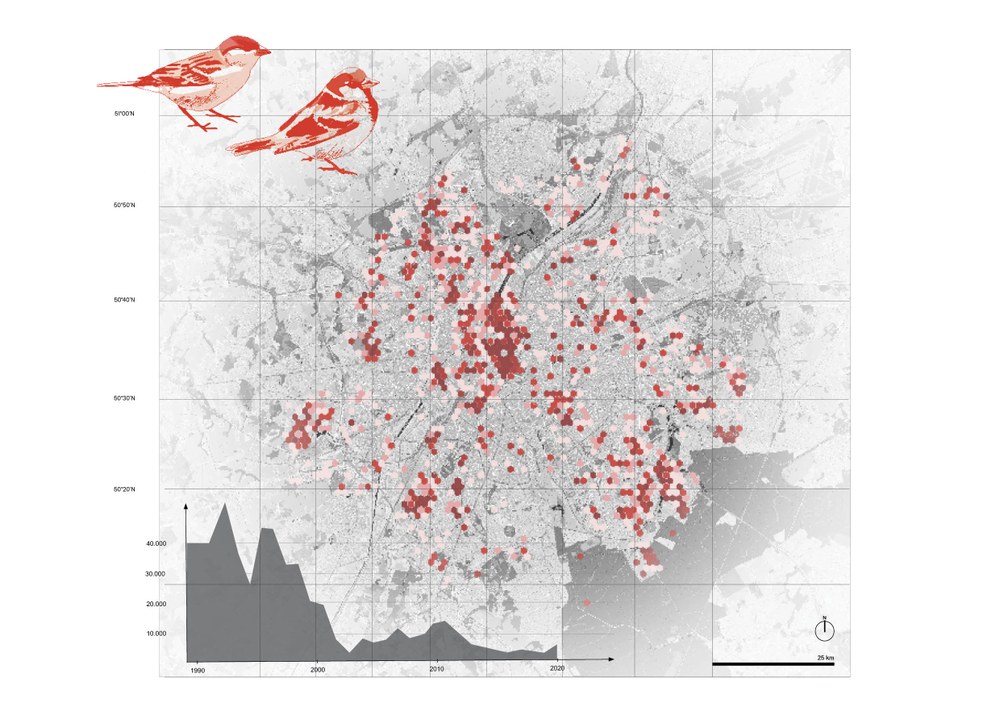
The project combines regional cartography, crowdsourced species observations, field investigations and design experimentation. Its atlas maps the movement and presence of selected urban animals across Brussels, while the Marais Wiels case study tests how mapping and design can disclose spatial relationships that conventional human-centred planning overlooks. The work is complemented by theoretical contributions on non-human agency, multispecies cohabitation and the politics of animal-inclusive design.
CO-HABITAT is a key bridge between the Lab’s research on agency, green infrastructure and post-growth urbanism. It demonstrates how cartography can function not only as representation but also as a design and political instrument, opening planning processes to the needs and capacities of other species while questioning who is entitled to shape metropolitan nature.
Daniela Perrotti
Founder and Director; Professor
University of Louvain
Marlène Boura
Postdoctoral Researcher in Data Science
University of Louvain
Larissa Bonifacio
Research Assistant
University of Louvain