REPORT
Co-habitat: Towards an Animal-Inclusive Design in the Brussels-Capital Region
A 170-page cartographic and design investigation into non-human agency and animal-inclusive urbanism in the Brussels-Capital Region.
Report information
AUTHORS
Björn Bracke; Koenraad Danneels; Marlène Boura; Anna Larissa Bonifacio; Nathan Van Loon; Manu Vanderveken; Guy Heutz; Damien Claeys; Hans Leinfelder; Bruno Notteboom; Daniela Perrotti
YEAR
2,024
REPORT TYPE
Research Report
ISSUING INSTITUTION
KU Leuven / University of Louvain
PAGINATION / IDENTIFIER
170 pages; ISBN 978-94-9278-027-0
INSTITUTION
University of Louvain
GEOGRAPHIC FOCUS
Brussels-Capital Region, Belgium
RESEARCH AXIS
Cross-Axis
FUNDING
Innoviris — Brussels-Capital Region
PARTNERS
KU Leuven; University of Louvain; Innoviris
THEMES
Animal-inclusive design; Multispecies urbanism; Ecological urbanism; Interpretative mapping; Non-human agency
METHODS
Cartographic analysis; interpretative mapping; systems modelling; biodiversity data analysis; research by design
Report overview
The CO-HABITAT report is a 170-page cartographic and design investigation into animal-inclusive planning in the Brussels-Capital Region. It assembles the project’s theoretical framework, regional mappings, species studies and research-by-design explorations.
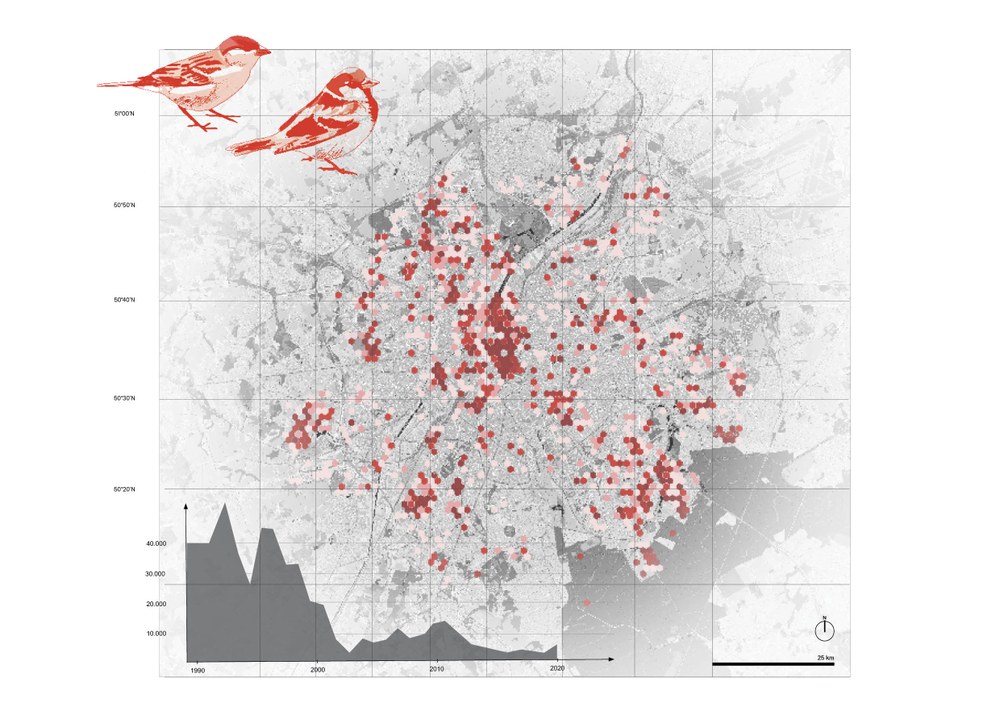
The atlas uses dynamic cartography and crowdsourced observation data to trace animal presence and movement across Brussels. A detailed investigation of Marais Wiels explores how a non-human perspective changes the reading and design of a contested urban site. Additional chapters address the politics and practice of other-than-human design and the methodological implications of multispecies cohabitation analysis.
As a collective research output, the report functions both as documentation and as a design instrument. It makes non-human agency visible at metropolitan and local scales and provides planners, designers and public institutions with material for discussing coexistence, habitat and conflict.